

Do the Driving Modes in Cadillac Lyriq Offer Different Ranges?
Electric vehicles promise efficiency, intelligence, and choice, and the Cadillac Lyriq leans heavily into all three. One of the most common questions new and prospective owners ask is simple but important: do the driving modes in Cadillac Lyriq offer different ranges or battery usages? The answer is nuanced, practical, and more interesting than a basic yes or no.
Driving modes in modern EVs are not cosmetic features. They actively shape throttle response, regenerative braking behavior, power delivery, and even climate system logic. Understanding how those elements interact in the Lyriq helps drivers make smarter decisions, reduce anxiety around range, and get the most from Cadillac’s Ultium battery platform.
Understanding Driving Modes in the Cadillac Lyriq
The Cadillac Lyriq uses software-driven vehicle dynamics to tailor how the SUV responds to different driving conditions. These modes adjust parameters like accelerator sensitivity, steering feel, torque mapping, and regenerative braking intensity, all of which influence energy consumption.
While the battery pack remains physically unchanged across modes, the way energy is drawn from and returned to that battery varies meaningfully. That variation is the foundation for understanding why drivers experience different efficiency outcomes depending on how and where they drive.
The Core Driving Modes Available in the Lyriq
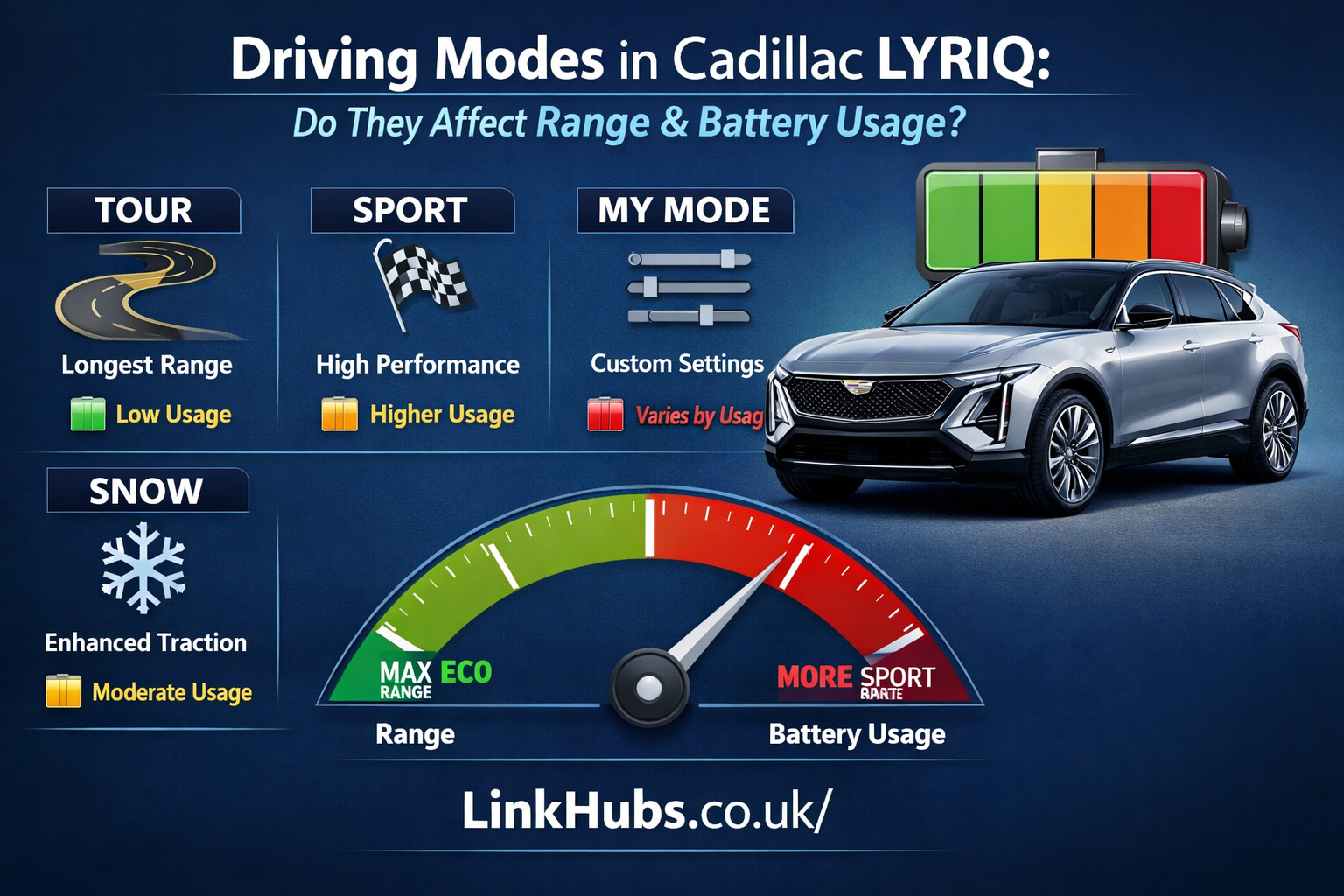
Cadillac equips the Lyriq with multiple standard drive modes, typically including Tour, Sport, Snow/Ice, and customizable My Mode. Each one exists to prioritize a specific balance between performance, comfort, traction, and efficiency.
These modes are not gimmicks. They represent different software profiles layered on top of the same hardware, and that software directly affects how quickly energy is consumed or conserved during real-world driving.
How Electric Vehicle Driving Modes Affect Range
In any EV, range is influenced by how smoothly power is delivered and recovered. Aggressive acceleration and reduced regenerative braking generally increase battery usage, while smoother torque curves and stronger regen support efficiency.
This is why the question do the driving modes in Cadillac Lyriq offer different ranges or battery usages? matters so much. Modes that encourage calm, predictable inputs typically extend usable range, while performance-oriented modes trade efficiency for responsiveness.
Tour Mode and Its Impact on Battery Usage
Tour Mode is the default setting for most Lyriq drivers, and for good reason. It balances throttle response, steering comfort, and regenerative braking to support everyday driving with minimal energy waste.
In practical terms, Tour Mode is usually the most range-friendly option for mixed city and highway driving. Power delivery is smooth rather than aggressive, which helps keep battery usage consistent and predictable across longer trips.
Sport Mode and Performance-Oriented Energy Consumption
Sport Mode sharpens throttle response and steering feedback, making the Lyriq feel quicker and more dynamic. That responsiveness comes at a cost, as power is delivered more aggressively with less smoothing.
Drivers using Sport Mode frequently may notice slightly higher energy consumption, especially in stop-and-go traffic. While the difference may not be dramatic on short drives, sustained use can measurably reduce overall range.
Snow and Ice Mode Efficiency Considerations
Snow and Ice Mode is designed for traction rather than efficiency. It limits torque output and softens accelerator inputs to prevent wheel slip on low-grip surfaces.
Although this mode is not optimized for maximum range, it does not necessarily waste energy. In slippery conditions, controlled torque can actually prevent inefficient wheel spin, which helps preserve usable battery capacity under challenging weather conditions.
My Mode and Custom Energy Profiles
My Mode allows drivers to tailor steering, throttle, and regenerative braking preferences. This flexibility means efficiency outcomes depend entirely on how the mode is configured.
A conservatively tuned My Mode can rival or even exceed Tour Mode efficiency in certain scenarios. Conversely, an aggressively configured profile can consume energy faster than Sport Mode, reinforcing the importance of thoughtful customization.
Regenerative Braking as a Range Multiplier
One of the most influential factors in battery usage across driving modes is regenerative braking. Stronger regen captures more kinetic energy during deceleration and feeds it back into the battery.
Driving modes that emphasize higher regenerative braking typically support better real-world range, particularly in urban driving. This makes regen behavior a central factor when evaluating whether different modes truly change battery usage.
One-Pedal Driving and Mode Interaction
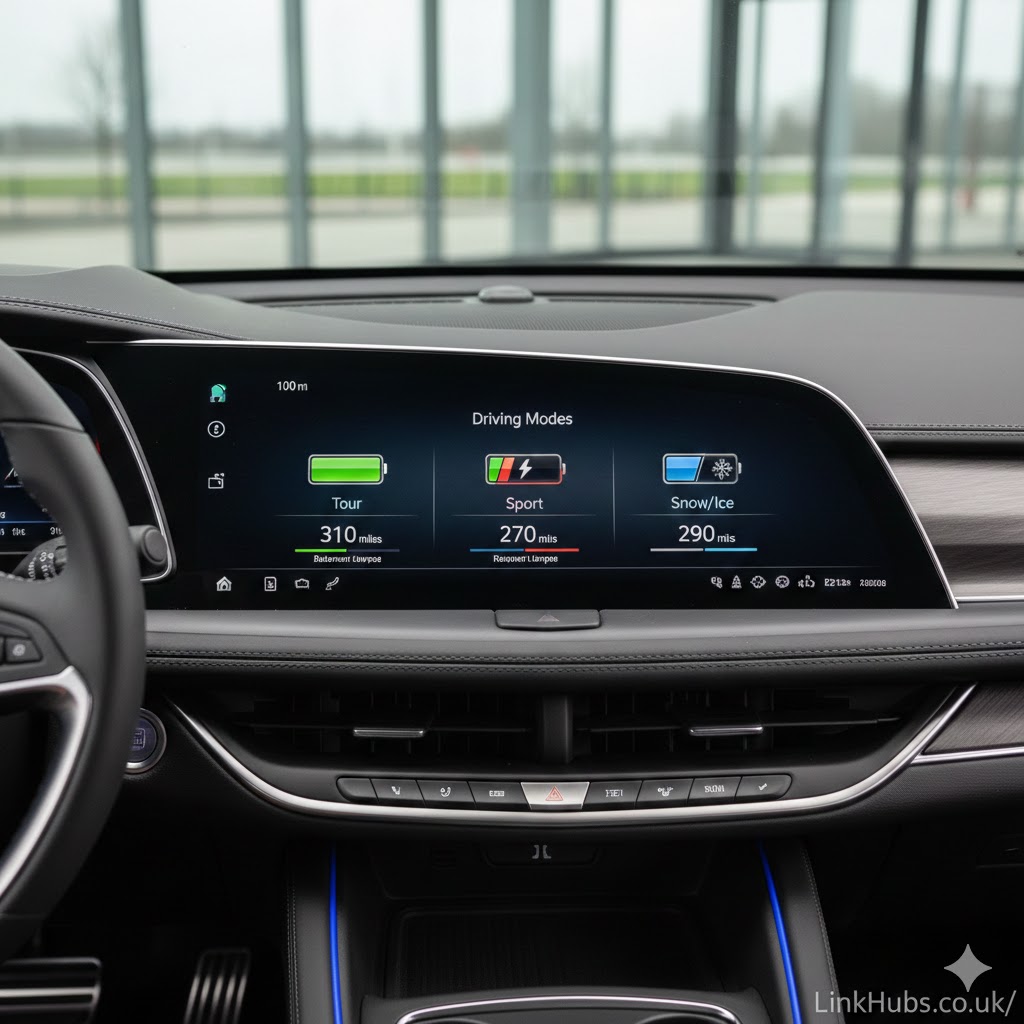
The Lyriq’s one-pedal driving capability works in tandem with selected drive modes. When enabled, it increases regenerative braking and reduces reliance on friction brakes.
In modes that already favor efficiency, one-pedal driving can significantly improve energy recovery. In performance-oriented modes, its benefits still exist but may be partially offset by aggressive acceleration.
Climate Control Behavior Across Driving Modes
Climate systems are a hidden but meaningful contributor to battery drain. Some driving modes subtly adjust how aggressively heating and cooling systems operate.
Efficiency-focused modes tend to manage climate loads more conservatively, especially during acceleration or high-demand situations. Over long drives, these small adjustments can contribute to noticeable differences in total energy usage.
Real-World Driving Conditions Matter More Than Modes
While driving modes influence energy use, real-world variables often have a greater impact. Speed, terrain, temperature, and driving style can overshadow the differences between modes.
That said, modes act as multipliers. Choosing the right one for a given situation can amplify good habits or worsen inefficient ones, making mode selection a strategic decision rather than a cosmetic preference.
Comparing Estimated Range Across Driving Modes
Drivers often ask whether the Lyriq’s displayed range estimate changes when switching modes. In some situations, it does, reflecting altered energy consumption assumptions.
However, range estimates are predictive rather than absolute. They adapt over time based on driving history, meaning consistent use of a single mode yields more accurate projections.
Table: Driving Modes and Expected Efficiency Tendencies
| Driving Mode | Throttle Response | Regen Strength | Typical Efficiency Impact | Best Use Case |
| Tour | Moderate | Balanced | Highest overall efficiency | Daily driving |
| Sport | Aggressive | Reduced | Lower efficiency | Dynamic driving |
| Snow/Ice | Softened | Moderate | Neutral to slightly reduced | Low-traction roads |
| My Mode (Eco) | Soft | Strong | Potentially highest | Urban efficiency |
| My Mode (Sporty) | Aggressive | Variable | Lower | Personalized performance |
This table highlights trends rather than guarantees. Individual outcomes depend heavily on driver behavior and external conditions.
Common Misconceptions About Driving Modes and Range
A widespread myth is that switching modes instantly adds or subtracts miles of range. In reality, modes influence how energy is used, not how much energy exists in the battery.
Another misconception is that Sport Mode is inherently wasteful. Used judiciously on highways with steady speeds, its impact can be modest, underscoring the importance of context.
Industry Perspective on Mode-Based Efficiency
Automakers increasingly rely on software-defined vehicles to fine-tune efficiency. As one EV engineer famously noted, “In modern electric vehicles, software decisions can influence energy use as much as hardware choices.”
The Lyriq exemplifies this shift. Its driving modes are less about rigid presets and more about adaptable energy management systems that respond to driver intent.
Cadillac’s Ultium Platform and Energy Management
The Ultium platform provides the hardware foundation that makes mode-based optimization possible. Its modular battery architecture and advanced power electronics allow precise control over energy flow.
This flexibility enables Cadillac to offer distinct driving personalities without compromising reliability or safety, reinforcing the Lyriq’s positioning as a premium electric SUV.
Long-Distance Driving and Mode Selection Strategy
For road trips, Tour Mode paired with conservative climate settings typically delivers the best balance of comfort and range. Smooth acceleration and steady speeds maximize efficiency regardless of mode.
However, occasional use of Sport Mode for passing or merging does not meaningfully harm range when used briefly. Strategic mode switching can enhance confidence without sacrificing efficiency.
Urban Driving Scenarios and Battery Usage
City driving emphasizes regenerative braking and low-speed efficiency. Modes that favor strong regen and gentle throttle inputs perform best in these environments.
In stop-and-go traffic, thoughtful use of one-pedal driving combined with an efficiency-focused mode can noticeably extend usable range over a full charge cycle.
Cold Weather, Modes, and Realistic Expectations
Cold temperatures reduce battery efficiency across all EVs. Driving modes cannot eliminate this effect, but they can help mitigate it.
Snow and Ice Mode prioritizes stability, while Tour Mode with conservative acceleration often yields the best compromise between safety and energy usage in winter conditions.
Software Updates and Evolving Efficiency
Over-the-air updates may subtly change how driving modes behave over time. Cadillac can refine throttle mapping or regen logic without altering physical components.
This means the answer to do the driving modes in Cadillac Lyriq offer different ranges or battery usages? may evolve as software improves, reinforcing the importance of staying current with updates.
Conclusion: Do Driving Modes Truly Change Lyriq Range?
Driving modes in the Cadillac Lyriq do not magically increase or decrease battery capacity, but they absolutely influence how efficiently that capacity is used. Through throttle behavior, regenerative braking, and system coordination, each mode nudges energy consumption in a specific direction.
For drivers seeking maximum range, understanding and strategically using these modes is one of the most effective tools available. The real advantage lies not in the mode itself, but in aligning it with driving conditions and personal habits.
Frequently Asked Questions About Lyriq Driving Modes
Do the driving modes in Cadillac Lyriq offer different ranges or battery usages?
Yes, the driving modes in Cadillac Lyriq offer different ranges or battery usages indirectly by changing throttle response, regenerative braking, and energy management behavior.
Which driving mode gives the best range in the Lyriq?
Tour Mode and efficiency-focused My Mode settings generally provide the best range by smoothing power delivery and maximizing regenerative braking.
Does Sport Mode significantly reduce battery range?
Sport Mode can reduce efficiency due to aggressive acceleration, but its impact is modest when used selectively or at steady highway speeds.
Can My Mode be more efficient than Tour Mode?
Yes, a carefully configured My Mode with soft throttle and strong regen can match or exceed Tour Mode efficiency in certain driving conditions.
Does switching driving modes change the battery size or capacity?
No, driving modes do not change battery capacity. They only affect how energy is used, which influences real-world range outcomes.

Leave a Reply